Reverberation Time is typically measured or calculated for a 60dB decay range (RT60). The following information will help you to appreciate the factors that affect reverberation time so that, after measurements have been made, appropriate changes can be suggested where necessary.
RT60 is heavily dependent on room volume, the amount of absorption in the room, and air absorption at higher frequencies. A popular approximation, based on Sabine’s formula, is:
 Where:
RT is the time it takes for reverberant sound energy to decay by 60dB (in seconds)
V is the volume of the room in cubic meters
c is the Speed of Sound in meters/second (varies with temperature)
A is the total sound absorption of room materials in square meter Sabines – i.e. the sum of surface areas, each multiplied by its respective sound absorption coefficient
m is the intensity Attenuation coefficient of air per meter (varies with temperature and humidity)
Typical Material Absorption Coefficients
Note that absorption coefficients vary with frequency.
Material Type | Typical Mid-Band Sound Absorption Coefficient |
|---|---|
Marble | 0.01 |
Plastered Walls | 0.02 |
Bare Brick | 0.03 |
10mm Plywood | 0.09 |
10mm Mineral Wool | 0.60 |
25mm Polyurethane Foam | 0.70 |
Acoustic Ceiling Tile | 0.72 |
Audience Member on Upholstered Seat | 0.88 |
A more in-depth list can be found here.
Air Absorption
Air absorbs sound quite significantly at higher frequencies due to molecular resonance. This high frequency air absorption varies with temperature and relative humidity in a way too complex to cover here. For further information, a useful air absorption calculator may be found here.
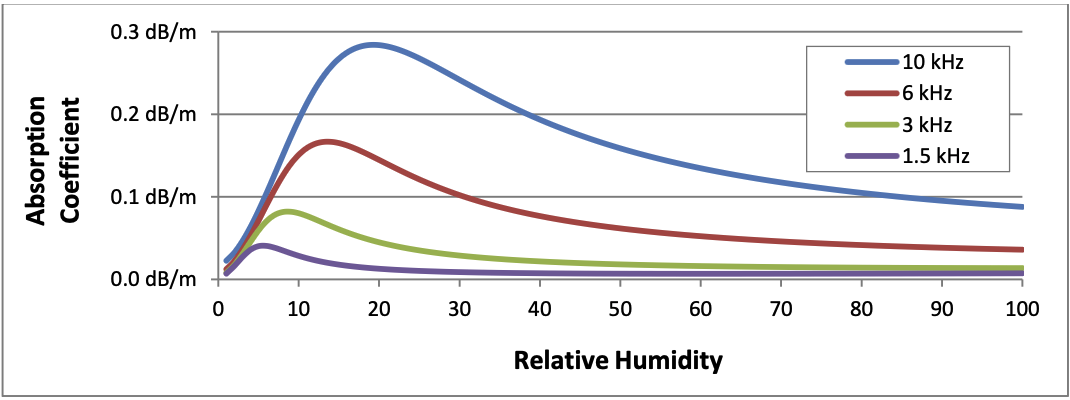
Air absorption (in dB/m) vs. relative humidity at room temperature.
Note that sound absorption through air is per meter – not per doubling of distance as seen for radial attenuation. Sound in a room with a mid-band RT60 of roughly 2 seconds will travel several hundred meters before decaying into the noise floor so air absorption is a significant additional factor in reducing high frequency reverberation times.
Schroeder Cut-Off Frequency
RT60 assessments are usually restricted to the Schroeder Frequency (or critical frequency). This is the crossover point between the stochastic region (high frequency range where sound paths are diffuse and random) and modal region (low frequency range heavily affected by room modes). In the region surrounding the Schroeder Frequency, modes start to overlap by a fairly arbitrary factor of three. The popular approximation published by Schroeder in 1962 is:
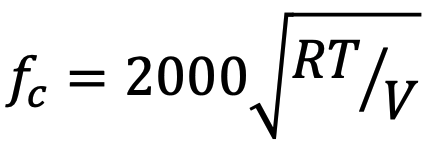
As before, RT is the time taken for the reverberant sound energy to decay by 60dB (in seconds) and V is the volume of the room in cubic meters. For room volume in cubic feet, the equation can be written as: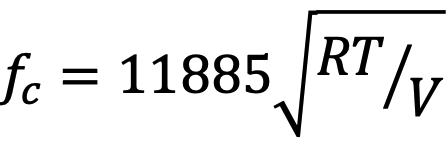
Practical Measurement Considerations
Most of the above equations are approximations that assume an omnidirectional sound source, homogenous sound distribution, and the possession of accurate venue information! In reality (where we typically perform our measurements), accurate venue information may be difficult to acquire and operating conditions may vary from event to event. Reverberation characteristics are also likely to vary slightly across the audience area and early decay characteristics will vary significantly from seat to seat. Because of this, accurate measurements, over a practical range of operating conditions, are recommended.
As most rooms have significant background noise levels (the noise floor), a full 60dB decay range isn’t always available – especially when the direct sound is at normal speech levels or, as is possible with Smaart, we measure a system with an audience in place.
For convenience, instead of measuring the full 60 dB decay time, the decay slope (in dB per second) is measured over a 30 dB range (preferred) and then doubled to work out the RT60. This scaling works, similarly to a car’s spedometer - You do not need to drive for an hour to understand how far you would travel if you continued at your current speed.
For a T30 measurement, slope is conventionally measured between the -5dB and -35dB points, as long as the lower point is at least 10dB above the noise floor. If the noise floor is exceptionally high, it may sometimes be necessary to measure the decay slope over a smaller level range. In that case a 20 dB range may be measured instead and then tripled to normalize to equivalent 60 dB decay time.
According to ISO 3382, reverberation time measured over a 30 dB range is called T30 and T20 signifies a 20 dB measured range. In their notation scheme, the letter T, by itself, stands for 60 dB decay time and so hopefully it is understood that the 20 and 30 refer only to the measured range. The stated reverberation time in seconds for either figure is the equivalent 60 dB decay at the measured rated of decay.
Typical values are as follows:
Venue | Reverberation Time (In Seconds) |
|---|---|
Talk Studio | < 0.5 |
Cinema/Auditorium | 0.4 - 1 |
Conference Room/Classroom | 0.1 - 1 |
Musical Theaters | 1 - 1.5 |
Chamber Music/Opera Venues | 1.5 - 2 |
Symphony Halls | 1.5 - 2.5 |
In practice, of course, acceptable ranges vary with expectations based on the venue size.