Early-to-Late Energy Ratios
Early-to-late energy ratios are another way of objectively characterizing the reverberant characteristics of a room. They are arguably a better measure than Reverberation Time for any venue where a sound system is an organic part of the acoustical equation. They are simple to calculate automatically and are not subject to the kinds of complications that can make measurement of reverberation times somewhat subjective, but they are a more recent innovation and may be less widely understood than RT60.
Clarity Ratios (C35, C50, C80…)
Clarity indexes are early-to-late energy ratios that compare the integral of the energy arriving within the first n milliseconds of the arrival of direct sound (inclusive) to the energy in the remainder of the reverberant decay period. The two most commonly used are C50 and C80, which use 50 or 80 milliseconds respectively as their split times. The result of the comparison is expressed as a Decibel ratio.
Shorter split times such as 35 or 50 ms, however, are regarded as better predictors of speech intelligibility. C80, on the other hand, is more useful for music. In terms of what kinds of numbers to look for, Gerald Marshall provided the below table in a 1996 Journal of the AES article titled An Analysis Procedure for Room Acoustics and Sound Amplification Systems Based on the Early-to-Late Sound Energy Ratio.
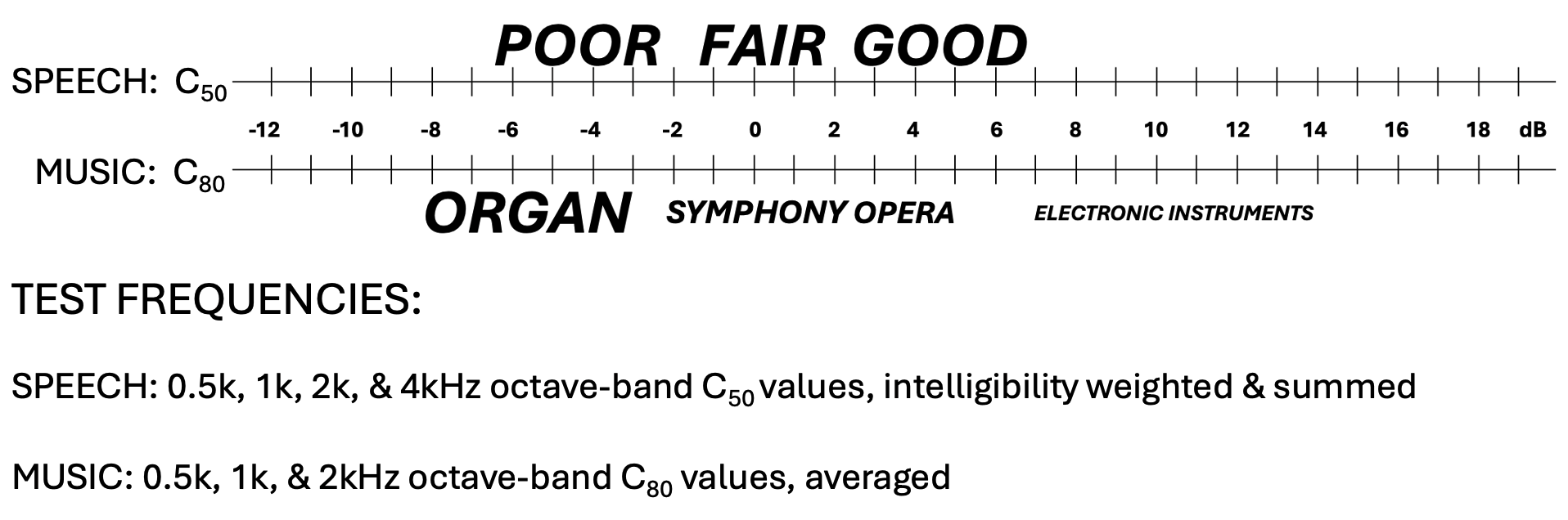
A recreation of Marshall’s scale for interpreting C50 and C80 measurement results for speech and music.
For the speech intelligibility scale, Marshall used a weighted average of the 500 Hz to 4 kHz octave bands, with the following weights assigned to each band: 15% for 500 Hz, 25% for 1 kHz, 35% for 2 kHz and 25% for 4 kHz. Others have used the weighting tables for Articulation Index, STI and scales of their own devising with similar results. For music, he used a simple average of the 500 Hz, 1 kHz and 2 kHz octave bands. We know of no applicable standards for this metric and it has been suggested extending the frequency ranges that Marshall used an octave higher for speech and two octaves higher for music might be useful, but hopefully this example provides a useful starting point for evaluation.